
Most veterinary websites don’t look broken.
They have clean layouts. Nice colors. A few stock photos of pets. A contact page. Maybe even a blog.
And yet… they don’t bring in new clients.
This is the problem no one talks about.
Your website might be “fine” from a design perspective, but if it’s not converting visitors into booked appointments, it’s quietly costing you revenue every single month.
This isn’t a design issue.
It’s a system issue.
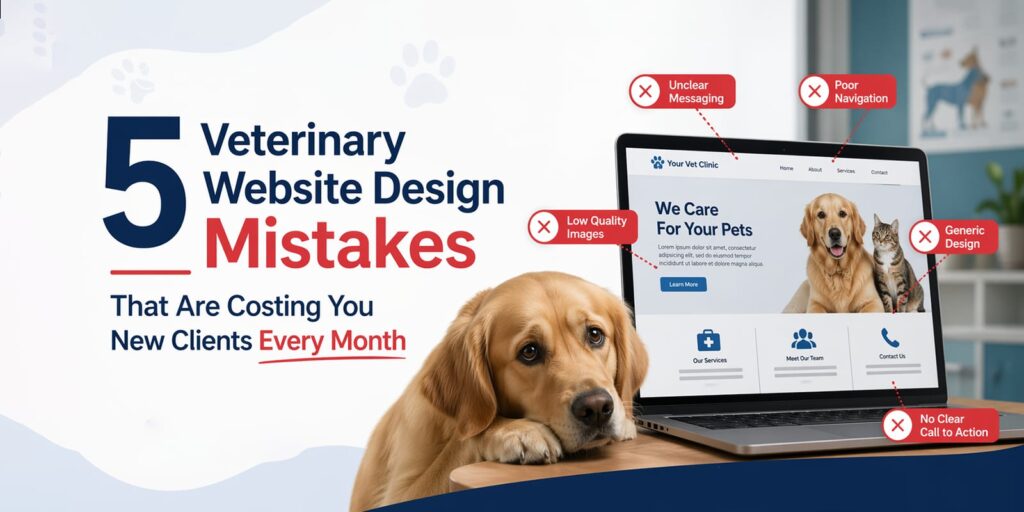
Let’s break down the five most common veterinary website design mistakes that are killing your growth and how to fix them.
What most vet websites get wrong
A visitor lands on your website.
Now what?
- Multiple buttons with different actions
- “Contact us” buried in the menu
- Phone number as the only option
- No clear next step
You’re forcing the visitor to think.
And when people have to think, they leave.
What this is costing you
Every extra step reduces conversions.
If a potential client can’t figure out how to book within seconds, they’ll go to the next clinic that makes it easier.
You’re losing:
- After-hours bookings
- Mobile users who prefer quick actions
- High-intent visitors ready to book
What high-converting clinics do instead
They remove friction completely.
- One clear primary action: Book Appointment
- Online booking visible on the homepage
- Sticky booking button on mobile
- Minimal clicks to confirm an appointment
Better yet, they integrate a virtual consultation option, capturing clients who aren’t ready to visit physically yet.
Mistake #2: Your Website Looks Good But Loads Slow
Why speed matters more than design
A beautiful website that loads slowly is still a bad website.
Most veterinary traffic is mobile.
If your site takes more than a few seconds to load, users are gone before they even see your content. According to Google’s Core Web Vitals guidelines, speed is a critical ranking factor for local businesses. Even a small delay can reduce conversions significantly.
The hidden revenue impact
Slow speed affects:
- Bounce rate (people leave instantly)
- Search rankings (Google pushes you down)
- Conversions (fewer bookings)
Even a small delay can reduce conversions significantly.
That means fewer appointments without you realizing why.
Fixing it the right way
Speed is not about installing random plugins.
It comes down to:
- Optimized images
- Clean, lightweight WordPress setup
- Performance-focused hosting
- Minimal unnecessary scripts
Most vet websites are bloated with themes and plugins they don’t need.
That’s what slows everything down.
Mistake #3: No Trust Signals (Why New Clients Don’t Choose You)
What’s missing on most vet websites
You might be a great veterinarian.
But a new client visiting your site doesn’t know that.
Most websites lack:
- Real client reviews
- Testimonials
- Photos of the actual clinic and team
- Certifications or credentials
Instead, they rely on generic claims like “we care about your pets.”
That means nothing to a new visitor.
How clients actually decide
Pet owners are emotional decision-makers.
They’re trusting you with something they care deeply about.
Before they book, they look for reassurance:
- “Can I trust this clinic?”
- “Do other people like them?”
- “Do they look professional?”
If your site doesn’t answer those questions instantly, they leave.
What to add immediately
- Google reviews embedded on your site
- Real photos of your clinic, staff, and patients
- Short case stories or success examples
- Clear credentials and experience
Trust is what converts first-time visitors into paying clients.
Mistake #4: Poor SEO Structure (You’re Invisible on Google)
The real problem
Most veterinary websites are not built for search.
They have:
- One generic “Services” page
- No keyword targeting
- No local SEO structure
- No content strategy
So even if your site looks good, no one finds it. This is where SEO for veterinarians becomes essential. When your site is built for search, it becomes a consistent source of new client inquiries.
Why this kills growth
No visibility means:
- No traffic
- No new clients
- No predictable growth
Meanwhile, other clinics in your area dominate search results simply because their websites are structured properly.
What actually works in vet digital marketing
- Dedicated pages for each service (vaccinations, surgery, dental care, etc.)
- Location-based optimization (your city, your area)
- Content that answers real client questions
- Proper headings, structure, and internal linking
When your site is built for search, it becomes a consistent source of new client inquiries.
Mistake #5: No Follow-Up System (Leads Come In and Die)
This is the most ignored problem.
And the most expensive one.
What most clinics ignore
- Missed calls are never followed up
- Website inquiries don’t get tracked properly
- No email capture
- No reminder system
A potential client shows interest… and then disappears.
The cost of inaction
You’re losing:
- Warm leads who were ready to book
- Repeat visits from existing clients
- Opportunities to build long-term relationships
This is not a traffic problem.
It’s a system failure.
Simple systems that fix this
- Automated email and SMS follow-ups
- Appointment reminders
- Online forms that capture client details
- Retargeting ads for visitors who didn’t book
Clinics that implement follow-up systems don’t just get more clients.
They get more value from every visitor.
What High-Converting Veterinary Websites Do Differently
They don’t just “look good.”
They are built to generate clients.
Here’s what sets them apart:
- Fast, mobile-first experience
- Clear and simple booking process
- Strong trust signals throughout the site
- SEO-driven structure that brings in traffic
- Built-in systems to capture and follow up with leads
This is what turns a website into a growth engine.
How to Fix These Issues Without Rebuilding Everything
Most clinics assume they need a full redesign.
That’s not always true.
In many cases, the problem is not the design itself.
It’s the lack of structure behind it.
Small changes can create massive impact:
- Adding a clear booking system
- Improving speed
- Building trust elements
- Structuring pages for SEO
- Implementing follow-up systems
You don’t need more traffic.
You need better conversion.
Ready to Turn Your Website Into a Client-Generating System?
If your website isn’t consistently bringing in new appointments, it’s not doing its job.
We help veterinary clinics:
- Set up high-converting websites
- Integrate online booking and virtual consultations
- Build SEO systems that bring in consistent traffic
- Implement follow-up systems that turn visitors into long-term clients
The goal is simple:
Get more appointments from the traffic you already have.
Book a demo and see how your website can start working for you instead of just existing.
FAQ
What makes a veterinary website high-converting?
A high-converting website has a clear booking path, fast loading speed, strong trust signals, and a structure optimized for search and user behavior.
How can I get more clients for my vet clinic online?
Focus on improving your website conversion, implementing SEO strategies, and setting up follow-up systems to capture and nurture leads.
Do I need online booking for my veterinary clinic?
Yes. Online booking makes it easier for clients to schedule appointments, especially outside business hours, increasing overall conversions.
How long does it take to see results from vet digital marketing?
You can see immediate improvements in conversions with website fixes, while SEO results typically build over 3 to 6 months.
