
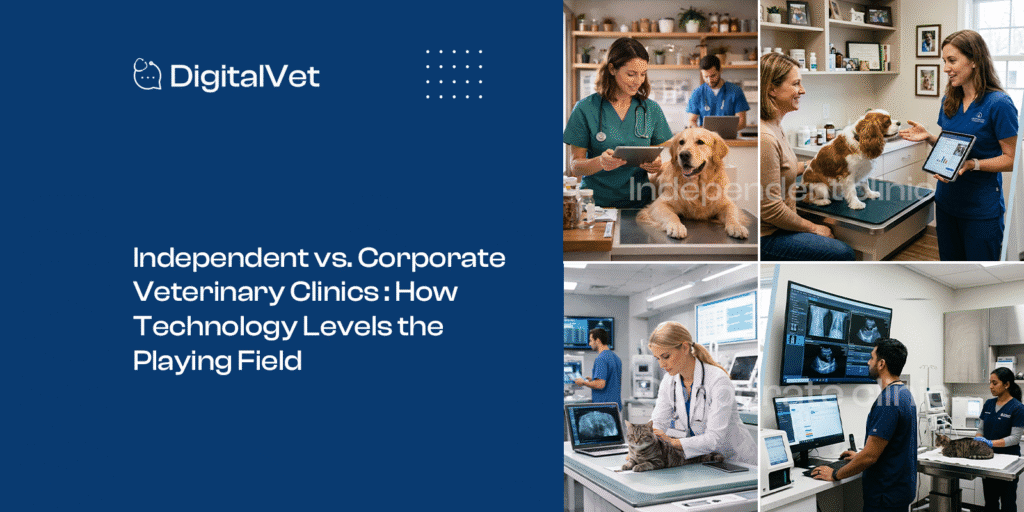
The veterinary industry is currently navigating its most significant transformation in half a century. If you own or manage an independent practice, you don’t need a market report to tell you that the ground is shifting. You see it in the glossy new clinic opening three miles away with a corporate logo, the aggressive recruitment offers hitting your associates’ inboxes, and the rising expectations of “Amazon-prime” speed from your clients.
Currently, corporate groups—backed by massive private equity—control roughly 50% of total industry revenue, despite owning only about 25% of the actual practice locations. This discrepancy reveals a hard truth: Corporate groups aren’t necessarily better at medicine; they are significantly better at systems.
For years, “Enterprise-level” technology was a luxury only the giants could afford. But the tide has turned. Today, the “David vs. Goliath” narrative has a new ending. With the advent of cloud-based, integrated digital suites, independent clinics can now deploy the same—or better—operational efficiency as a 500-unit chain, all while maintaining the local heart that corporate models can’t replicate.
Decoding the Corporate Advantage
To beat the competition, you have to understand their playbook. Why do corporate consolidators (like Mars, NVA, or VCA) scale so efficiently? It isn’t magic; it’s a three-pronged reliance on centralized infrastructure.
1. The Power of Centralized Reporting
In a traditional independent clinic, “data” often lives in a dusty corner of a legacy server. To see how many new clients you gained last month or your average transaction value (ATV), you might have to run three different reports and spend two hours in Excel.
Corporate groups, however, have “dashboards.” At any moment, a regional manager can see which clinics are underperforming on dental recommendations or where inventory shrinkage is eating margins. They manage by the numbers, allowing them to fix leaks before they become floods.
2. Hyper-Automated Communication
Corporate clinics treat client communication like a marketing funnel. They don’t wait for a receptionist to remember to call a “lost” client. Their systems automatically trigger:
- Two-week pre-appointment reminders.
- Two-day SMS confirmations.
- Post-visit “How did we do?” surveys.
- Lapsed-patient “We miss you” campaigns.
3. Rigorous Workflow Standardization
When a tech or vet joins a corporate group, there is a “Standard Operating Procedure” (SOP) for everything—from how the phone is answered to how a wellness plan is pitched. This creates a predictable, repeatable experience that allows them to plug in new staff and get them productive in days, not months.
The Myth of the “Automation Tax”
There is a long-standing myth in the veterinary community that “Automation equals Coldness.” Many independent owners fear that by implementing high-tech systems, they will lose the “family feel” that defines their brand.
This is a fundamental misunderstanding of what technology does.
Actually, the “Manual Tax” is what kills your clinic’s culture. When your front desk staff spends 4 hours a day playing phone tag for appointment confirmations, they are too stressed and busy to greet Mrs. Jones and her nervous Golden Retriever with a smile.
Automation is the “Humanity Enabler”
By automating the mundane, repetitive tasks (booking, reminders, refills), you give your staff their time back.
- The Corporate Reality: Staff are often “slaves to the software,” checking boxes to satisfy a corporate auditor.
- The Tech-Forward Independent Reality: Staff use software to remove the “busy work,” allowing them to spend more time in the exam room educating clients.
Why “Cloud-Based” Changed the Economics of Competition
A decade ago, an independent vet wanting “Enterprise” software had to buy expensive servers, pay for IT maintenance, and deal with clunky VPNs. Today, the “Cloud” has democratized power.
Scalable Pricing (Pay-As-You-Grow)
Modern platforms like Digital Vet Suite operate on SaaS (Software as a Service) models. This means a solo practitioner pays a fraction of what a multi-location group pays, yet they both have access to the exact same cutting-edge veterinary practice management tools. You no longer need a $50,000 upfront investment to have a world-class booking system.
Speed of Implementation
Corporate groups are like oil tankers; they take miles to turn. If a corporate group wants to update their software, they have to pilot it in 10 locations, get board approval, train 2,000 employees, and deal with legacy hardware.
An independent clinic is a speedboat. You can decide to modernize your client communication on a Monday and have it fully operational by Friday. This agility is your greatest competitive advantage—if you choose to use it.
5 Digital Pillars for the Competitive Independent Clinic
If you want to level the playing field this year, you don’t need to change everything. You need to focus on these five high-leverage digital pillars.
1. Synchronized Online Booking
The modern pet owner is likely a Millennial or Gen Z. They don’t want to call you. They want to book an appointment while sitting on their couch at 9:00 PM.
- The Corporate Standard: Real-time booking that syncs with the calendar.
- The Independent Opportunity: Move beyond “Request an Appointment” forms. Use a system that allows clients to see actual openings. This reduces your front-desk call volume by up to 30%.
2. Unified Communication (The “Single Pane of Glass”)
If your client communication is spread across a landline, a separate texting app, and a personal email, things will fall through the cracks.
- The Strategy: Centralize everything. Every text message, email, and phone log should be attached to the patient record automatically. This ensures that whether Dr. A or Dr. B sees the patient, they know exactly what was discussed last.
3. Digital Treatment Plans and Estimates
Stunned silence in the exam room when a client sees a paper estimate is a profit-killer.
- The Strategy: Use digital tablets to present treatment plans. They allow for “Tiered” options (Good/Better/Best) and digital signatures. It looks professional, reduces “sticker shock” through clear visuals, and ensures the client feels in control of the decision.
4. Integrated Payments and “Text-to-Pay”
The “checkout line” is the least enjoyable part of any vet visit. Corporate groups are moving toward “frictionless” payment.
- The Strategy: Implement text-to-pay. Let the client pay from the exam room or from their phone after they get home. It speeds up room turnover and improves your cash flow.
5. Proactive Health Monitoring (AI and Wearables)
The next frontier where independents can win is “Proactive Care.” By using integrated platforms that can track data from wearables or simple recurring digital check-ins, you become a partner in the pet’s life, not just a place they go when the pet is sick.
The Competitive Advantage of “Agility”
We often hear independent owners say, “I can’t compete with their marketing budget.” While you might not spend $10,000 a month on Google Ads, you have something a corporate group can never buy: Hyper-Local Relevance.
Technology allows you to amplify that relevance.
- Local SEO: Because you are a single location, you can optimize your digital presence for your specific neighborhood better than a corporate SEO firm managing 500 pages.
- Personalized Content: You can send a video message from you—the owner—to your clients. A corporate CEO can’t do that.
- Community Integration: Your digital tools can help you partner with local shelters or groomers, creating a digital ecosystem that keeps clients within the “independent” circle.
How to Transition Without the Headache
The biggest barrier to technology isn’t cost; it’s the fear of the “Transition Period.” Many vets are still using 15-year-old software because they fear losing data or having a week of “down-time” where the clinic descends into chaos.
The modern migration process has evolved.
Cloud-to-cloud transfers are now standard. At Digital Vet Suite, we’ve refined the process so that your data is mapped, your staff is trained in “bite-sized” modules, and the “Go-Live” day feels like a celebration, not a crisis.
Don’t Get Left Behind, Get Ahead
The “Corporate vs. Independent” debate is often framed as a battle of “Efficiency vs. Heart.” But that is a false choice.
The future of veterinary medicine belongs to the High-Tech, High-Touch clinic. These are independent practices that use enterprise-level systems to handle the “business” so they can focus 100% of their emotional energy on the “medicine.”
Corporate groups have systems, but you have the soul of the community. When you add the right systems to your soul, you don’t just “level the playing field”—you own it.
Your Next Step to Independence
You don’t need a corporate board of directors to give you permission to modernize. You just need the right partner.
Digital Vet Suite was built specifically for the independent clinic owner who refuses to settle for “good enough” technology. We provide the enterprise-level booking, communication, and reporting tools you need to stay competitive, without the “big box” complexity.
Stop fighting your software and start growing your practice.
Book a Personalized Walkthrough of Digital Vet Suite Today
See how we can save your staff 10+ hours a week and improve your client retention in 30 days.